
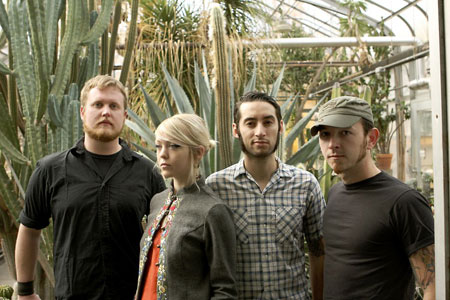
Brooklyn by-way-of Colorado band Chairlift caught America’s ear in late 2008, when iPod graciously decided to use its quirk-pop single, “Bruises,” in the ad campaign for the new Nano-Chromatic. (“I tried to do handstands for you …”)
That indelibly catchy single is one of maybe two exceptions on Chairlift’s otherwise thoroughly dark and creepy album, Does You Inspire You (re-released by Columbia Records on April 21), a surrealist take on ’80s electro-pop. It’s hardly a mass-appeal album, but with “Bruises” luring hapless pop fans in like a siren, it’s able to sink its teeth in long enough to infect.
Team Last Call caught up with guitarist, co-vocalist and super-weirdo Aaron Pfenning during the band's spring tour with The Killers.
Team Last Call: What’s the experience been like for you over the past year or so?
Aaron Pfenning: The experience has been so Technicolor. It’s gone from plaid to denim.
TLC: It’s denim?
AP: Yeah. That’s the fastest and easiest way to explain the last couple years.
TLC: Has it been difficult adjusting to all of the media attention?
AP: It doesn’t bother me. Media like YouTube comments?
TLC: Media like the 36-page press kit of interviews your publicist sent me.
AP: [Our publicist is] on top of everything. I guess we have surrounded ourselves with people that we really like to work with and that we trust. Essentially, we can kind of stay focused on staying free spirits. So I think that the attention, since that was your question, hasn’t really affected us much. We’ve still been in our own world.
TLC: Career-wise, have things gone like you’d hoped since the commercial started airing?
AP: I think so. I think the commercial was a huge baseball bat in the face, in a good way. The iPod commercial was like, wham. It just kind of all came together at once.
TLC: I don’t think I want a baseball bat to the face, even in a good way.
AP: Yeah, that’s probably the wrong way to explain it. Maybe a baseball bat to a baseball.
TLC: Do you remember seeing the commercial for the first time?
AP: I was actually in an Apple store picking up my computer. My computer was getting repaired. I walked in and one of the employees was playing it behind the desk.
TLC: Did you tell the person it
was you?
AP: I think I mumbled something about it and they just thought I was crazy. So I just paid for my computer and left.
TLC: There is a creepy, sinister thing going with your music. Where does that come from?
AP: I think dark music is far more interesting. Caroline [Polachek, singer] and I started writing music basically as a soundtrack for haunted houses. When we were in Colorado, I had a big shed in my backyard and she and I would just drink a bunch of yerba maté tea and just stay up all night coming up with really frightening music.
TLC: You’re portrayed as a bunch of weirdos.
AP: Uh-huh.
TLC: Do you think you’re, um, atypical?
AP: We’re not super-strange. We’re just a little bit off. Oddballs. I’ll go into a meeting with Columbia and five minutes into it I’ll realize that, “Oh, shit. I just said something that really freaked people out.” I totally have to catch myself. It’s not how most people talk or how most people think of things. Columbia, I have to give them a lot of credit, because they took a really big risk on a band that’s pretty far out there. Patrick [Wimberly], our drummer, he’s pretty responsible. He’s like the Great Gatsby of Nashville. He’s such a ladies man, and so on top of everything, whereas Caroline and I, we’ll just wander off, like we did today, and no one knows where we are and we lost track of time.
TLC: You’ve described your music as an antidote to living in New York.
AP: In the course of making the album, we realized how over-stimulated we’ve become living in New York. Constant going out to clubs and noise everywhere. You go from ice cream trucks and busses to cars and people yelling on the street, and then you go into a club and there are people yelling at the bar, all these wizards and techno magicians everywhere blasting things at you. There’s visual imagery everywhere. It kind of never stops. So we figured out how to make music that was a little more calming. It’s affective in the most minimal and haunting and memorable way.
 In December, I started growing a beard that, while it’s probably just coincidence, definitely helped the Eagles get into the playoffs. It was a mighty beard, a beard of hope, a beard to light the way in dark times. It was a beard you can believe in.
Then, of course, the Eagles got trounced in the NFC Championship Game, and I assumed that my beard’s magical powers had fizzled out. As it turns out, quite the opposite was true – as I discovered less than a week after the Super Bowl, when my wife’s pregnancy test came up positive.
My wife and I had been trying to conceive for several disappointing – and, I might add, beardless – months by that point, and things just weren’t looking good. But then I grew my beard of virility and our dream was realized. And now, my face clad in furry manliness, I am preparing to enter the magical world of diapers and singing purple dinosaurs and sleep deprivation called fatherhood.
Our magical beard-induced pregnancy is terrific for a number of reasons, including the fact that I’ll finally have a proper photo for my profile on Facebook, where, unless you’re holding a baby, your friends literally can’t even see you. Plus, until the baby comes in October, we get to use the sweet parking spaces at the grocery store. And in December, we can give all of our friends and family the greatest gift of their lives, a Christmas card with our family’s picture on it.
One potential problem with the pregnancy is that I kind of don’t like kids. My sister’s kids are two of the most magnificent creatures on Earth, but beyond that, I just don’t care for children. The crying, the pooping, the complete inability to hold their liquor – it’s just not for me. And if they have any appreciation whatsoever of the Philadelphia Eagles, they certainly don’t know how to show it. They’re messy and selfish and think the whole world revolves around them, and so do I, and that’s a bad combination.
And yet, I sit here already dizzyingly, incomprehensibly, inside-and-out saturated with love for this baby of mine, which as I write is somewhere between the size of a strawberry and a plum. It has arms and legs and is just now starting to develop facial features, including what looked in the sonogram to be the beginnings of a fine-looking beard. It also theoretically lost its tail this week, which seems like a positive thing to me. Presumably, it’s also well along in the development of its Steelers-hating gland. Good baby.
It’s mind-blowing to think that there will soon be a little person running around that got half of its genetic makeup from me. There goes its career in the NBA. It can also forget about ever figuring out the square root of anything, or the difference between baking soda and baking powder, or how to change a tire. But while it’s stranded helplessly by the side of the road waiting for AAA to show up, it’ll be able to write lots of sarcastic jokes about its own ineptitude. That’s called a life skill.
My friends have been an endless source of support throughout these early weeks of pregnancy, taking time out of their busy schedules each day to e-mail and text encouraging notes like “Say goodbye to your freedom” and “Your life is no longer your own” and “You’ve just been given a life sentence.” Neat things like that. And they’re all dads, too, so I know they’re just loving this. Suffice it to say, I’m acutely aware that my life is about to change. Forever. But I have a feeling that whatever sacrifices I have to make won’t be anything my beard and I can’t handle.
In the months since discovering my wife was pregnant, I’ve been stuck in a perpetual state of what I can only describe as excitement with a side of white-hot terror. I think about the baby approximately once every five seconds, and each time say the exact kind of word that I shouldn’t use anymore now that I’m going to be a dad. Everything I see now is viewed through the eyes of an expectant father, meaning that everything is broken down into three basic categories: bad for baby, really bad for baby and Rush Limbaugh. For example, my car is a death trap that shakes and sputters and doesn’t have functioning seatbelts in the back seat, and is therefore bad for baby. My Jack Russell is genetically programmed to hunt down and devour small animals, and seems to find small children particularly tasty, and is therefore really bad for baby. And Rush Limbaugh is a lumpy, antagonistic, pill-popping demonic gasbag, and is therefore Rush Limbaugh.
The point is, the world seems like one big, bad, dangerous place when you’ve got a baby on the way. I’m already prowling around the house like a bear protecting its young from danger, by which I mean Rush Limbaugh, even though all I’ve seen of the baby are squiggly ultrasound images of it doing backstrokes inside my wife’s belly. I love that little strawberry to a terrifying degree. Elizabeth Stone once wrote of having a baby, “It is to decide forever to have your heart go walking outside your body.” Now I’m starting to understand what she meant.

Part of my morning routine each weekday is to listen to WITF’s call-in program Radio Smart Talk, a terrific new show that I appreciate for both its insightfulness and the fact that it means one less hour a day of classical music.
Several weeks ago, Radio Smart Talk did a program about a new gun law that has already been passed in many parts of PA. Apparently, the “lost gun law,” as it’s called, is causing quite an outrage within the NRA community, which is a very bad thing, in that these people by definition like to spend their downtime shooting things. In order to smooth out the situation, I’d like to, in a completely unbiased and not at all gun-hating way, take a moment to more fully explain the law.
The several gun owners who called in to the program came across as intelligent and reasonable and not at all like the kind of people who would murder someone who made fun of them. That being said, I’d still like to clarify that I’m not interested in choosing sides or stirring up trouble that in any way could result in me getting shot a lot. I promise to be understanding and respectful of gun owners and extremely sensitive to the fact that they know where I work and what I look like. So any readers expecting to see a column full of fiery rhetoric about how owning a gun is “lame” or “dumb” or “super-lame and dumb” is going to be very disappointed.
It just so happens that I love guns. I also love NASCAR, plus Old Milwaukee beer, and agree wholeheartedly that Sarah Palin should be president because she’s hot. So clearly, there’s no need for anyone to shoot anyone else.
And now, without any further ado about the fact that I would totally marry a gun if I could, it’s time to take a look at the law. The “lost gun law” can basically be summarized as such: If you own a gun, and that gun is lost or stolen, your wife and children will be sold to a democrat. Just kidding! All it says is that you’re required by law to report your missing gun to authorities within 72 hours. That’s it.
As many gun owners have astutely observed, this law is a clear violation of their god-given rights, especially their right to lose their deadly weapon and not do anything about it. But here’s why the law is important: It will help to cut down on the widespread practice of “straw sales,” or the sale of guns by legal gun owners to people who have no business being anywhere near a gun, like a terrorist, or Dick Cheney. Which I realize is redundant. Under the old law, when a gun is discovered at a crime scene and traced back to its original owner, the owner can simply claim that he lost the gun. While the gun owner in this scenario is, technically speaking, an idiot, he is not a criminal, and is therefore off the hook. But under the new law, that person would at least be held accountable if he knowingly lost his gun, especially if he knowingly lost it under a bag of money handed to him by a felon.
How you can prove that someone knew his gun was missing is unclear. But even if the law has some imperfections, it’s sure to at least slow down the illegal sale of weapons. So to me, the law is worth passing, even if you can’t always enforce it. I mean, you’d never be able to enforce a ban on listening to Nickelback’s music, either, but that doesn’t mean it’s not the right thing to do.
According to the NRA, all this law does is “victimize the victims” of gun theft. And they’ve got a point. First someone takes your gun, and now you’re forced by law to report it? That’s oppressive. Next they’ll expect you to go crying to the police every time someone steals your car.
But all lawmakers are really asking is that 1) if you own a gun, you do your very best to not sell it to terrorists, and 2) if you do sell it, I mean lose it, just give the police a little heads-up that there’s a new deadly weapon on the streets. If it helps, think of your gun like a baby: There’s no law that prevents idiots from having a baby, but there is a law penalizing them for knowingly losing one. And way less people have been shot and killed by lost babies than lost guns. To reiterate, no one here is arguing a person’s right to own a gun. Gun ownership is protected by law, and I’ll support it until the day I die, which hopefully isn’t soon via gunshot.
There are some people out there, like Jesus, who say that owning a gun is wrong. Maybe if these crybabies weren’t so busy growing out their hair and hugging trees and “living their lives according to the Bible,” they’d have time to read the Second Amendment for once. The fact is, gun owners have a right to bear arms. And the only way they can get the bear arms off the bear’s body is by shooting it with their guns.
In summation, everyone on Earth can and should have a gun. That way, if anyone ever shoots you, you can shoot them back, and they can shoot you back, and all of your friends and your dog and your grandma can join in and everyone can run around shooting everyone else all the time, just like the Constitution says. God bless America.
 The world is facing many crises theses days, from the economic recession to the trouble in Gaza to oh my god did you hear that Lindsey Lohan broke up with her girlfriend?
But none of those crises – at least as far as our local TV channels are concerned – is quite as monumental as the switch to digital TV, which, unless you’ve spent the past year in a coma or are currently dead, you already know happens on February 17.
The reason you know that is because, approximately every 30 seconds, a very loud person comes on the TV to tell you in a very loud voice that you need to purchase and install a digital converter box right now before the entire world collapses into a deep, dark void of penetrating nothingness for all time. Other consequences of failing to install a converter box prior to the 17th include, but aren’t limited to, oral herpes, certain death and, worst of all, not having TV. I also read somewhere that they’re going to start killing a baby bunny every hour, on the hour, until every last household in America has digital TV, although I haven’t been able to double-source it. Then again, I did read it on Wikipedia, so it’s probably not true anyway. Then again, I’m the one who posted it on Wikipedia, so it’s definitely not true (en.wikipedia.org/wiki/Digital_television).
It’s become increasingly clear to me that history will show the switch to digital TV to be the great challenge of our time. Sure, the war on terror is “important.” And global warming might “kill all life on planet Earth,” blah, blah, blah. Ooh, we’re so scared, global warming! Frankly, here in the age of digital TV, those issues have become peripheral at best.
AIDS and poverty already had their day in the sun. World peace is so 2008. We as a society are not going to be judged by how we handle some trivial issue of a bygone era. Our greatness will be determined by how we join together and rise up in 2009 to destroy all obstacles in our path – no matter how many human lives it costs – in order to ensure that every last man, woman and child on Earth has free and easy access to Dr. Phil.
It’s OK to be scared. It’s not every day that the world faces a crisis that makes the bubonic plague look like a case of the sniffles. And no one likes to see baby bunnies die, no matter how necessary it may be. But it’s imperative that we step up to the challenge. Do you think Neil Armstrong wasn’t afraid to take that first step on the moon? Do you think Ghandi wasn’t afraid when he resisted the British Empire? Do you think Aragorn wasn’t afraid to lead his dwindling army on a march against the Black Gate of Mordor in order to distract Sauron and his army of Uruk-hai so that Sam and Frodo could destroy the Ring of Power in the fires of Mount Doom?
Of course they were scared. What matters is that they pushed through the fear, and helped to make Earth, not to mention Middle Earth, a better place.
You might be wondering, “How can you compare the act of buying a converter box to the work of Ghandi, let alone Aragorn?”
Before you get all worked up, just take a moment to imagine a life without TV. I mean, think about it: No Sean Hannity. No NASCAR. No The Hills. No Deal Or No Deal. Yikes, right? A world without the wit and wisdom of Howie Mandel is no world for me.
In conclusion, Ghandi might have helped a nation gain its independence, but we are the ones who will ensure that, for generations to come, everyone still gets to watch every single episode of America’s Got Talent. Did you see the Rappin’ Granny? Oh, priceless!
Granted, there are a few drawbacks to digital TV, including the need to buy the converter box, and possibly a new antenna, plus a new TV. And the signal is all-or-nothing, so if there is any interference at all, all you get is a blue screen – but you can always just pretend that they zoomed in really, really close on a Smurf. That’s called making lemonade.
But clearly the negatives of digital TV are far outweighed by the catastrophic consequences if you don’t get it, which also include asphyxia, soreness and elephantiasis of the testicles. And yet, millions of Americans still haven’t gotten their converter boxes, so many that in early February – right after karma makes the Steelers lose the Super Bowl because their fans are dirty, awful, fat-faced traitors – congress might vote to push back the digital TV deadline to June 14.
America is playing with fire. It’s up to you and me to push this country forward, to fulfill the dreams of our forefathers, to fight and bleed and die under the proud flag of 24-hour Rock of Love marathons. Now, go get that converter box. If you don’t do it for yourself, for the love of God, do it for the bunnies.
 Barry Manilow is a lot of things, and “reserved” is not one of them. And the mawkish music legend is every bit as dynamic in conversation as he is on record, whether he’s talking about how he created the power ballad, hamming it up about his age or discussing the fact that he’s become a walking punch line.
In the past four years, Manilow, now 65, has padded his already staggering career numbers with the release of a series of albums covering the “greatest hits” of the ’50s, ’60s, ’70s and ’80s (The Greatest Songs of The Eighties hit shelves in November) and a wildly successful Vegas show.
Team Last Call: Between this series of albums and the Vegas show, you’ve had what could be considered a real career renaissance over the last four years or so. What’s that been like for you?
Barry Manilow: I don’t consider it a renaissance. I never went away! I’ve just been doing my thing for all these years. Artists like myself, it’s like a roller-coaster. It just keeps going, and sometimes it’s very high and sometimes it’s low. But with me, the lows haven’t been too low, thank goodness. And the highs have been thrilling.
TLC: In the ’90s, your focus shifted to cover material, by and large, and I’ve seen you lament that fact in a few interviews. Can you talk about that?
BM: It’s all about Clive Davis and his wisdom about what records will sell. As a creator myself, I always want to create an original. But like he does with every artist on his label, he says, “It’s not always about being creative. It’s about what the public will like.” Since I’m an arranger and I’m a musician and producer, I can figure out how to make [cover material] work without feeling like I’m giving everything away. I see the fun in it. There does come a point every so often where I say, “Stop! I have to release an original thing. Stop! I have to do one for myself.”
TLC: I imagine it’s an interesting tug of war, with these albums debuting at number one, number two …
BM: If they all were released and they all just died on the vine, it would have been easy to just say, “Well, I gave it a try, and now I’ll go back to doing my original stuff and join the rest of the out-of-work composers and struggle along.” But [Clive’s] got this incredible talent of being able to zero in on what the public would like, so I am the grateful recipient of this man’s gift. Plus, my original stuff will never sell as well as what Clive gives me. But it will give me so much encouragement and so much inspiration that I can ride on that for the next couple of years, if he’s interested in coming up with some other cockamamie idea for a cover record.
TLC: You’re nominated for a Grammy for In the Swing of Christmas. What does that kind of thing mean to you at this point in your career?
BM: It’s a wonderful thing. They find me now and again and they give me a nod. It’s great. I didn’t expect that at all. What was interesting is that this Christmas album had nothing to do with Clive, had nothing to do with popularity, had nothing to do with charts. Isn’t that interesting? It had nothing to do with commercial success or having a committee listen to it and say, “Hey, we like this!”
TLC: People have this idea of Barry Manilow as a balladeer, like Johnny Mathis, but you’ve protested that in the past.
BM: Maybe some of the real big hits were ballads. But even my beautiful old ballads had a lot of passion, where Johnny, who I’m a great big fan of, sings much more gently. Keep in mind, I’ve always been on the border of rock and roll. As a matter of fact, people credit me for inventing the power ballad, which I think I might have done. “Mandy” was the first power ballad. They keep copying that style, with the piano and [how] the song builds and the key changes and the ending. They still do it. So therefore, I don’t know why people think all I do is sit at a piano and sing love songs. Boy, that’s about the last thing I do.
TLC: It’s been about 35 years since “Mandy” …
BM: Boy, am I an old fart! Holy mackerel! Thanks for reminding me.
TLC: Sorry about that. So, when you were that kid, being transformed into a pop superstar, are you thinking at that point, “I might have a career in 2009”?
BM: Oh, never. Never. But I’ll tell you what I did think: I knew I would land on my feet. I never thought I’d have this kind of career. But even when it began, it didn’t matter to me, and hey, it still doesn’t. I know that it sounds ungrateful, and I don’t mean it to sound ungrateful, but this career, the money, the huge success, doesn’t really matter. What matters is that I get the opportunity to still do it, and for that I am grateful, so grateful to the public and to the record companies and to Clive. But I don’t do it for anything but [the fact that] I can’t not do it. If I hadn’t been successful, I probably would have been really unhappy – but I wouldn’t have stopped.
TLC: You’re bringing the Ultimate Manilow show to Reading. Do you ever sort of impress yourself with the amount of hits you pack into the set?
BM: Impress myself? [laughs] Yeah, sometimes it’s overwhelming. It is. That I can fill up 90 minutes with music that everybody knows – that’s pretty amazing.
TLC: So, you’re this hugely successful and beloved artist, and on the other hand, one of the most mocked. What do you make of that polarity?
BM: You know, the bigger you get, the more you get [ridiculed]. A lot of people like what I do, and a lot of people have trouble with it or they make fun of it. If that’s what happens when you become really, really popular, I’ll take it. They can make fun and I’ll laugh along. People making fun of me? Everybody gets it, but usually everybody gets it for about two years. I’ve [been talked about] for about 30 years, so I’m a very happy guy. People can say whatever they want.
TLC: What else is there for Barry Manilow to achieve?
BM: There’s always something in the pipeline for me. I’ve got five more ideas that I’m developing right now. There’s always five more. And I don’t even care whether they’re successful. I just love that I come up with great ideas that thrill me. That thrill me! And I don’t care whether they stick to the wall. If some of them don’t, it doesn’t matter. I’ve just got millions of ideas. I’ll be on my deathbed, and I’ll be yelling, “Wait a minute! I’ve got one more!”
On record, Murder By Death singer Adam Turla sounds downright menacing, his deep baritone resonating with a Mark Lanegan-meets-Glenn Danzig growl of apocalyptic foreboding. Over swinging, shuffling, post-punk Americana, he flings phrases about infidelity, plunder, whoring, destruction, murder, gods, demons and utter desolation with a detached snarl, mercilessly scraping the bottom of the barrel for the starkest stories and bloodiest plot twists imagination allows.
But on the phone, he sounds really menacing. On a mid-January morning, he fumbles with the receiver and, after some under-the-breath grumbling, growls a curt “hello.” Irritation. Frustration. Were I a character in one of his dark, sprawling concept albums, he’d probably have one of my legs gnawed off by some foamy-mouthed hound of hell.
Fortunately, a few minutes and one funny story about a drinking game called Wizard Staff later, Turla is in a decidedly better mood.
“I’m generally a pretty happy person,” he insists. “I’m doing our band’s taxes right now, though, so when you called me I was wallowing in a sea of misery. I’ve been doing it for 30 hours. It’s killing me.”
Turla’s doing some last-minute office work before he and the rest of Murder By Death hit the road for a February tour that will feature, for the first time, the band playing the entirety of its newest album, Red of Tooth and Claw, and its 2003 storyline sequel, Who Will Survive, And What Will Be Left Of Them?, in sequence, stringing together an epic adventure that involves burning towns, stabbings, adultery, divine interventions, lots of vomit, lots of piss, lots of whiskey and the shooting of the devil in a Mexican town. If Cormac McCarthy ever decided to write a Broadway musical, this might be the score.
Red of Tooth and Claw is far from an obvious prequel. In fact, many of the band’s (sometimes overzealous) fans are still not aware of it, which is something Turla intended.
“Who Will Survive … had a real cult thing going on – there were all sorts of stage productions and ballets, there’s a doctoral thesis written about it that someone sent me, just all sorts of weird, obsessive versions of it,” Turla laughs. “So when this album came out, I didn’t want to just pander by saying it was [a prequel] to get people to go out and buy it.”
Musically, Red of Tooth is a dark and sinister splattering of Americana ornamented with Sarah Balliet’s ominous, droning cello and careening rockabilly beats that throw the songs up on two wheels. With the exception of the borderline-optimistic closing track, “Spring Break 1899,” which Turla claims actually comes closest to his personal worldview, it’s a bleak and heavy listen. And even the last track isn’t exactly what you’d call happy.
“’Spring Break 1899’ is a really happy, ’50s-sounding, dreamy ballad, but the lyrics are about pissing and shitting yourself because you’re drunk and worthless,” Turla chuckles. “Happiness is not interesting.”
Turla may not use it as song fodder, but Murder By Death does have plenty to be cheery about, from its mountain of critical acclaim to the tours it’s landed alongside likeminded bands such as Against Me! and Lucero, as well as Turla’s longtime idols, The Pogues. But why dwell on the bright spots when there’s misery to be had?
“There have been years when we have zero money and eat beans for a month,” Turla laments. “Then again, … I think that making good material comes out of desperation, of necessity. So in that way, I appreciate being in this line of career and not ever having it be peaches and cream.”
*Reprinted from Fly Magazine
 This is an ode to Mr. Puddy, the world’s most constipated cat.
Mr. Puddy passed away on July 31 at the age of 17. He was a beloved pet, a good mouse-catcher and a role model for elderly, incontinent cats everywhere.
Puddy is survived by his parents, a Jack Russell, a cocker spaniel, a girl cat and a boy cat. His absence has lowered the pet-to-room ratio from an admirable 5:6 to a dismal 2:3. The magnitude of his loss cannot be overstated.
My wife and I loved Mr. Puddy to the utmost degree, or at least to the utmost degree you can love a cat that pees on your pillows. There were times when we wished for his death, and there were times when we wanted to kill him ourselves, but as more and more of our friends have children, I’m realizing that this is really the norm.
Mr. Puddy was our firstborn. My wife and I got him nine years ago on our first Christmas together from a friend who worked in a vet’s office. Peanut, as he was called then, had been brought in to be euthanized due to what his previous owners called a “bad disposition,” which is a euphemism for “he’s crotchety and pees everywhere.” We didn’t know that at the time.
All we knew was that a seemingly innocent cat was about to be put to death, and his name was Peanut. If there is one rule to live by in this world, it’s that you just don’t kill anything named Peanut.
We could tell right away that he was a dignified cat, the kind you could easily imagine in a top hat and monocle. But not, as we found out later, the kind that would actually wear a top hat if you put one on him. He would wear fake reindeer antlers at Christmastime, but that might say more about the Velcro chinstrap than Mr. Puddy’s yuletide spirit.
Mr. Puddy began peeing on our stuff the instant he touched ground in our house. Rugs, mats, recliners, couches, slippers – nothing was sacred. Some our friends were quick to judge, especially when he would pee on, say, their coats, or maybe their children. But those kinds of things really shouldn’t be left lying around our house anyway.
The truth was, we loved Mr. Puddy immediately, even if he was sort of an a-hole. He was ours, the first thing that was really, truly ours. Sure, he had his problems, but I could say the same thing about our friends’ kids. At least Mr. Puddy never peed his own pants.
Mr. Puddy’s other problem was that he ate obsessively. Eventually, he got so fat that he couldn’t even clean himself, resulting in a greasy, dandery stripe of hair running down his back that ranked just below Gary Busey’s teeth on the grossness scale. His fatness also made him lose the ability to meow like a normal cat. Instead, he emitted something closer to an “ech,” which we thought was hilarious. We would use it as a party trick, and people loved it. “Go get that cat,” they’d say. “Make him do that thing that’s funny!”
“Ech,” Mr. Puddy would say, and the room would erupt.
This became less funny the day that we realized that the “ech” was happening because, while Puddy had ballooned in size, we had never thought to loosen his collar. Underneath it was a perfectly bald ring that ran completely around his neck. We felt appropriately terrible, although it did make him look like clergy, which was sort of funny.
Years went by, and Puddy continued in his ways, peeing on our most valuable belongings with quiet, haughty pride. Then one day last July, he stopped eating. Just stopped. We were concerned, and took him to the vet’s office, where the doctor conducted a series of blood tests and x-rays. The conclusion was that Mr. Puddy was fantastically, colossally constipated, literally the most constipated cat the doctor had ever seen. This called for an overnight stay at the veterinary’s “feline resort,” which is like a human resort, except that instead of being pampered with massages and chocolates, Mr. Puddy was given a nonstop series of enemas.
We brought him home the following day, full of optimism that our now substantially lighter cat would resume eating. And he did. There was joy all around. The next day, however, the doctor called me at work to deliver some bad news: Some post-cat-enema testing revealed a tumor. It was cancer that was blocking Mr. Puddy’s intestines. Cancer that would require an operation that a 17-year-old cat just wouldn’t survive.
Within a few days, Puddy stopped eating again, stopped drinking and started bleeding out of his nose. By the time we took him back to the vet just a few days later, he was sunken and emaciated. The vet encouraged us to put him down.
Mr. Puddy was 8 years old when we’d adopted him, meaning we had ultimately more than doubled his time on earth. He’d had a good run. There was nothing else we could do. Plus, there wasn’t that much left in our house for him to pee on anyway.
Putting Mr. Puddy to sleep was far worse than I had imagined. We wept openly and cradled his little
body, warm and limp in the towel. His little chest was as still as an empty cradle. It wasn’t even real. Eventually, we signaled to the nurse that we were ready to let him go. We said a final, tearful goodbye and handed him over.
That’s when we saw it, a little yellow puddle glistening on the leather couch between us. It was pee. Mr. Puddy’s last pee. His final protest against the indignities of the world. One last hurrah, one last middle finger in the air, like a punctuation mark on his life.
“Farewell, cruel world!” he said. “Ech!”
One more ruined couch, one more notch in his belt. We laughed like hell. And somewhere up in kitty heaven, so did Mr. Puddy.
